

Data analytics is a rapidly growing area that is revolutionizing how businesses operate. An MBA with a data analytics specialization can help you develop the skills and knowledge necessary to pursue a career in this exciting field. An MBA in data analytics will prepare you to take on leadership roles and help organizations make better decisions based on data.
In this blog post, we will explore the benefits of an MBA with a data analytics specialization and how it can help you reach your career goals.
What Is an Online Data Analytics MBA Degree?
An online data analytics MBA degree is an advanced business degree focusing on using data and analytics to drive business decisions. This program combines traditional business skills with data analysis to give students the tools to become experts in the field.
The degree typically includes courses in economics, finance, marketing, and operations management, along with courses focused on data analytics. The degree will also cover topics related to software engineering, programming, and computer systems so that graduates can develop custom data-driven solutions for their organizations. Students will learn how to analyze data from multiple sources and leverage it to make sound business decisions.
Online MBA data analytics programs prepare students to work in a variety of data-driven roles, such as data analyst, data scientist, marketing analyst, and business intelligence specialist. The curriculum typically covers topics such as statistics, data mining, predictive modeling, and machine learning, as well as business management principles. Additionally, these programs offer specialized courses in analytics and data science to give students a deeper understanding of the technical aspects of the subject.
The Ever-Growing Demand For Data Analytics
Data analytics is an increasingly important field in the modern business world as businesses of all sizes strive to make better decisions faster and more effectively. As a result, demand for data analytics professionals has skyrocketed in recent years. With the emergence of big data and sophisticated analytics technologies, companies can now analyze vast amounts of information to uncover trends and insights that were previously impossible to detect.
Companies are using data analytics to gain valuable insights into customer behavior, improve operational efficiency, better understand the market, and even predict the future. Data analytics is also used to develop new products and services, identify potential opportunities, and optimize marketing campaigns.
The Skills You’ll Learn In An MBA Program With A Data Analytics Specialization
With an MBA program with a data analytics specialization, you’ll gain a range of highly sought-after skills that are vital in today’s data-driven business world.
- You’ll learn the fundamentals of data analytics, such as data mining, data visualization, and predictive modeling.
- You’ll also gain an understanding of how to use statistical methods to analyze data and draw meaningful conclusions. With this knowledge, you’ll be able to make informed decisions about the most effective ways to use data for business purposes.
- You’ll develop a deep understanding of the ethical implications of using data and learn how to protect it from security threats.
- You’ll also acquire the necessary skills to identify customer needs, build customer relationships and target your marketing efforts.
- The MBA program will equip you with the managerial skills to lead and motivate a team of data analysts.
- You’ll learn how to set objectives, create strategies and evaluate progress to achieve results. All of these skills are invaluable in any organization where data plays an important role.
The Job Market For Data Analytics Professionals
No matter what type of role you are looking for, having an MBA with a data analytics specialization will give you a competitive edge in the job market. Employers know that an MBA degree indicates advanced knowledge and skills related to business administration and management, which makes you an attractive candidate for any type of data-related position.
The job opportunities for data analytics professionals are plentiful, ranging from management positions in corporate environments to freelance roles working remotely. You could be hired to work on projects related to risk assessment, customer segmentation, financial analysis, marketing campaigns, or any number of other tasks that require data analysis. You could also find yourself in demand for roles related to cybersecurity, healthcare, or government intelligence, as well.
In addition to traditional job opportunities, the growth of big data has opened up many freelance opportunities for data analytics professionals. Freelance gigs provide flexible hours, a chance to try different types of projects, and the ability to choose the type of clients you work with.
The Salaries You Can Expect To Earn As A Data Analytics Professional
If you have an MBA with a data analytics specialization, you can expect to earn a very competitive salary. As the demand for data analysts continues to grow, employers are willing to pay top dollar for talented individuals who have the necessary skills and experience. With the right qualifications, you could find yourself earning a lucrative salary in no time.
In general, the salaries of data analytics professionals depend on their skill level, experience, and location. An entry-level data analyst might make an average of $60,000 per year. As your skills improve and you gain more experience, you could move up to positions such as Business Intelligence Manager or Data Science Manager, where salaries can range from $90,000 to $150,000.
In some cases, the salaries of data analytics professionals can be even higher. Of course, salaries for data analytics positions vary depending on location and other factors.
Conclusion
If you are interested in data analytics and want to take your career to the next level, earning an MBA with a data analytics specialization can be a great option. You will gain valuable skills that are highly sought after in the job market. You can use data analytics to solve complex problems and make informed decisions for your business.
In addition, as a data analytics professional, you can expect to earn salaries that are among the highest in the field. Ultimately, an MBA with a data analytics specialization can provide you with the skills and knowledge necessary to become a successful data analytics professional.
In 2019, I made over $13,000 from my side hustles. During the year, I rented out rooms in my house, performed statistical consulting, and helped small businesses with their websites. In this post, I’m going to share with you my thoughts on each of these side hustles and talk about how you can start a side hustle this year to earn more money.

In 2019, I was busy and had a great year side hustling. During the year, I made $13,416 from my side hustles.
This was a fantastic year in terms of hustling, and helped me on my path to building a solid financial foundation for my future.
The reason I side hustle is because I want to speed up the time to reach financial freedom.
While some weeks and months can get very busy, this extra income has helped me pay off debt, build my emergency fund, and invest in my future.
My three side hustles I did in 2019 was house hacking, statistical consulting, and freelance web design.
Each side hustle is different and unique in what I did, but also how I got started. Below I’ll talk more about these differences and how I’ve grown these hustles over time.
Side hustling isn’t for everyone, but I definitely recommend it if you are looking to improve your financial situation.
For me, this was my third year of seriously hustling. One thing I’ve learned is balance is very important in life. What I mean is that I don’t recommend having 3 side hustles – I’ll get into this more though later on.
In this post, I’m going to talk about the side hustles I performed in 2019, give you some side hustle ideas for 2020, and hopefully inspire you in your hustles.
Finally, note, I’m not including any money I’ve made from this website in this article. In 2019, I brought in a few thousand dollars, but spent more than I made on this site. You can see this in my three year blogging anniversary post.
How I Earned Over $10,000 in Side Hustle Income Last Year
As I mentioned above, in 2019, I earned $13,416 from side hustling.
First, let’s take a look at the numbers.
You can see below my side hustle income by month:

This was a great year, and I’m very fortunate and blessed that I have the free time to do these hustles.
The most lucrative side hustle is my statistical consulting side hustle. In 2019, I made $8,691 from my statistics side hustle. I’ve been doing this side hustle for 3 years now, and spend a handful of hours a month helping dog doctors and veterinarians with their statistical research.
The second side hustle from 2019 I performed was house hacking. For the first five months of 2019, I rented out space in my house and collected $3,050 in rent (I stopped house hacking because I sold my house in July).
The third side hustle from 2019 I performed was freelance web design. During 2019, I worked with a few different small businesses.
With these businesses, I helped build and design their websites in WordPress, and helped with other website related tasks (email forms, theme customization, site migrations, etc.) to help push those businesses along. For my web design contracting work, I made $1,675 over the entire year.
For the rest of the post, I’m going to talk about each of these side hustles in greater detail.
By going into more detail, you can learn more about each side hustle and see if they might make sense for you! 🙂
 Making Money By Helping Dog Doctors with Statistical Studies
 Making Money By Helping Dog Doctors with Statistical Studies
My first side hustle is consulting for dog doctors. Three years ago, an former co-worker of mine approached me with an opportunity to help do some statistical consulting.
For $85 an hour, I help these dog doctors perform statistical analysis, and these analyses work their way into published manuscripts.
The work I’m doing isn’t rocket science, but it’s necessary to get the results required these doctors want.
For example, I run a lot of simple regressions, ANOVA analyses, chi square tests, and look for cases of statistical significance.
Most of this is college level statistics, but it’s not anything someone with a background in numbers couldn’t learn.
In this case though, I was able to leverage my connections and previous work to secure this side hustle.
By showing my worth, I was able to connect with a former co-worker, and now, I’ve been able to bring in about $20,000 over the last three years with this hustle.
You never know who could be valuable at work, so it’s important not to burn bridges!
Renting Out My Rooms and House Hacking to Make More Money
Back in the summer of 2015, I bought a three bedroom house and rented out the other rooms to my friends.
For four years, I house hacked, and was able to make passive income every month with the rental income.
House hacking is a fantastic way for someone in their 20’s to make extra money every month.
If you can afford it, buying a house and renting out your extra space can be very beneficial for improving your financial situation.
As I mentioned, I sold my house in July because I wanted more flexibility and the price was right.
But before the sale, this side hustle was mostly passive and helped me with my mortgage payments.
Housing is one of the biggest expenses you will have on a monthly basis, and with house hacking, you can reduce this expense drastically.
For the most part, house hacking isn’t that much of a time commitment. At the same time, owning a house can be a lot of work, and this is where things can get expensive.
However, if you are going to have a house and extra space, why not rent it out?
House hacking changed my life, and through house hacking, I was able to make $3,050 this past year. I’m definitely thankful for this and am excited to get into real estate again in the future.
 Helping Small Businesses with their Websites through Web Design
 Helping Small Businesses with their Websites through Web Design
The third side hustle I did in 2019 was freelance web design for small businesses.
When I started this blog at the end of 2016, I didn’t know anything about HTML, CSS, php, or Javascript.
After taking some free courses on Code Academy, I started to make customizations on this website and learning more about these different web programming languages.
Use and action is so important to learning a new language – programming or foreign!
During my first year of blogging, I kept learning more and more about web design.
After a year, and after meeting a lot of different bloggers at FinCon 2017, I connected with a few people needing website updates.
As I grew my portfolio, I was able to get more clients and exposure through word of mouth.
Now, I’m comfortable with:
- front-end design
- back-end development
- integrating with different web services (email, payments, automation)
- and many other things WordPress
These are all skills I love using and in 2019, I was able to leverage these skills to help others.
By providing value to others, I can make a little money and help others who need a technical hand.
This one is probably my favorite side hustle, but it’s quite time consuming to find clients.
Now, I want to talk about other side hustle ideas that you could use to make some more money in 2020. But first, I’m going to talk about what is the best side hustle.
What’s the Best Side Hustle?
When starting on your side hustle journey, you might ask, “what’s the best side hustle?”
In my opinion, the best side hustle is providing value to another person or company and doing what you want with your free time outside of your day job.
There are a number of possibilities to choose the best side hustle. The best side hustle might be the one that makes a ton of money. Maybe it’s one that brings new opportunities and helps you in your day job. Perhaps it’s one that brings passive income and allows you to retire early!
Really though, the best side hustle comes back to doing what you enjoy – without necessarily caring about the profit potential of the endeavor.
We all have limited time on this Earth.
Let’s say you love teaching yoga (or some other athletic class). When you teach, you make $100 a session. Even though you only do a few sessions a week, you still love it and have had a ton of great experiences through your teaching.
This side hustle might not be the most lucrative (though a few hundred bucks a week is pretty good), you are doing what you want and enjoying your life.
Again, in my opinion, the best side hustle is doing what you want with you time and potentially making money in these endeavors.
But really, my opinion is just my opinion. You are entitled to your own opinion and can decide what the best side hustle is for you!
Now, let’s get into the list of side hustle ideas you can consider for this next year to increase your side hustle income.
18 Side Hustle Ideas You Can Consider This Year to Earn More Money
In the world, there are hundreds of ways to make extra money each month to further your financial situation.
In the following list, I tried to focus on ways you can make money in the real world.
When searching for “how to make more money”, you will find a lot of spam and “get rich quick” schemes.
I prefer to focus on providing value to those around and you to help others directly.
While I do believe you can help others through a platform or through passive actions over time, some of the best side hustles come from doing the work yourself and directly interacting with your customers.
Below is a list of 18 side hustle ideas you can think about to make money on the side of your day job.
- Tutor Students
- Help with Yard Work
- Edit Audio or Videos for Others
- Build Furniture or Make Household Items
- Referee Sporting Events
- Start a Business
- Help Others with their Businesses
- Bookkeeping
- Web Design
- Social Media Marketing
- Freelance Writing
- Content Creation
- Graphic Design
- Rent Out Your Spare Things
- Sell Your Stuff and Become a Merchant
- Help Move People Out of their House
- Edit Resumes
- Invest in Income Producing Assets
- Deliver Things in Your Car or Bike
While these side hustle ideas are great, like I said, there are hundreds of other ways you can make more money in the world.
I have just scratched the surface of what you could possibly to do make money.
A side hustle could possibly be created by thinking of the following questions:
- What do you love doing?
- Is there anyway you can turn that into a hustle?
- How can you help others and provide value to make a little more money on the side?
These are all questions you can think about as you decide whether or not you can and will start a hustle this year.
Real World Examples of Side Hustlers and Side Jobs
On The Mastermind Within, I’ve had the pleasure and honor to feature some amazing side hustlers in my Side Hustle Spotlight series.
These side hustlers are making great money on the side of their day job. Here is a list of the side hustle interviews I’ve featured so far:
- Tutoring
- Consignment Store Flipping
- eBay and Online Marketplace Flipping
- Musician
- Food Tour Guide
- Sports Press Box Worker
Hopefully, these amazing interviews give you inspiration to start your own side hustle (and if you do, I’d love to hear about your side hustle!!)
Are You Going to Side Hustle This Year to Improve Your Financial Situation?
2019 was a great year for me and my side hustles. I was able to make more than $10,000 on the side of my day job, and use this money to improve my financial situation.
For me though, I don’t think I’d recommend doing multiple side hustles at once – especially if they are active and take up your time.
It’s important to have balance in life and to not burn yourself out.
Three side hustles, a day job, and other goals is too much for me, and in 2020, I’m only going to actively pursue my consulting gig. If people ask me to help with their website, I’ll do this, but I’m not going to be looking for clients.
As I mentioned, there is more to life than hustling and trying to push and push and push. Family, health, learning, goals, faith, friends, etc. – all of these things are important as well to consider before diving into a hustle.
Now, it’s your turn.
Do you have any financial goals for this year? Are you looking to make smarter financial decisions, save more money, or pay down some debt?
How would a side hustle play into this? What would a few hundred dollars do for your bank account?
I hope this article has been interesting and inspiring for you.
Hopefully we both can make 2020 a lucrative year and crush our financial goals!
Thanks for reading and happy side hustling!
Readers: what’s your side hustle? Are you looking to start or continue a side hustle in 2020? What are some other questions you have about side hustling?


What is money really? Why is money so important? Why does money matter? In this post, I’m going to answer these three money questions and talk about how you can use money to create a great life. Money is a tool, and you can use your earnings and money to create a life which is forth living.

What is money?
This is a simple question, with a seemingly simple answer.
But, really, what is money?
Also, what is debt? Are they the same thing?
In this post, we will explore the simple question of what is money, why money is important, and how you can use money to live a life worth living.
What is Money?
 First, what is money?
I typed “what is money?” into Google and got a ton of hits – all from financial and information websites (Investopedia, the IMF, Wikipedia, and Economics and Liberty)
Most of what I looked at had similar definitions of “what money is”.
Money, simply put, is a medium of exchange.
Societies throughout history have used money to make it easier to exchange and trade goods.
Very early on in history, humans used bartering as the main way to exchange and trade goods. “I’ll give you 2 pounds of grain for 1 gallon of milk” was probably close to a common trade back in the day.
Unfortunately, milk and grain go bad after a certain point, and humans looked to other things they could use to facilitate these activities.
Silver, gold and other precious metals were used, and over time, paper and digital forms of money have been introduced to facilitate the exchange of goods, services, and capital.
The type of money (silver, goods, cash, etc.) is determined socially, be it by a governing body or by the people in a given market.
At this point, I could go into the functions of money, what are some of the properties of “good” money, and talk about “why fiat currency is the best form of money and why cryptocurrencies have no intrinsic value” (or is it the other way around?), but these are just distractions from the question we are trying to answer of “what is money?”
What I don’t like about the simple definition above is that is ignores the fundamental constraint of the world: energy.
Money is a Number for True Capital and a Claim on Energy
While many financial analysts, actuaries, and investment professionals believe in the energy tooth fairy (i.e. energy will always be plentiful because of technology or because oil never runs out), it’s my belief that energy needs to be considered when talking about finance.
With this in mind, our definition of money from above needs tweaking.
Here’s what I believe the true definition of money is: money is a claim on a certain amount of energy.
Think about it, with $25, you could pay someone to cut your lawn for you (which requires energy), or you could spend an hour of your valuable time and keep your $25 (but in this case, you personally have expended energy).
The more money you have, the more things you can do because you can afford to use a certain amount of energy.
Speaking a little more in general, the cost of buying something (monetarily), should be roughly equal to the amount of energy (be that actual energy, joules) put into producing that something.
Over time, as processes become more efficient, the cost of goods should decrease, because efficiency leads to lower uses of energy during production.
If Money is Energy, What Can We Conclude?
After establishing a definition, it’s good to look at some of the results and logical statements we can conclude from it.
First, if money is claim on a certain amount of energy, then we can say the following:
- Having more money is good, as it allows you more options.
- If money is a claim on a certain amount of energy, then debt is a future claim on a certain amount of energy.
With these conclusions, I want to try to answer a few questions.
First, why is money important? Second, how should you think about money? Third, why does having more money in the bank matter? And, finally, how can you use money to create and live an interesting and fun life?
Why is Money Important and Why Does Money Matter?
First, why is money important? Why does money matter?
Let’s start with an easy question: at a basic level, what do human beings need to live?
Shelter, clothing, food, and water.
Going a step further, some other needs include education, sanitation and relationships.
Unfortunately, there’s no such thing as a free lunch, and all of these things cost money.
The purpose of money, in my opinion, is a that money should be viewed as a tool for us to facilitate the purchases of our needs and wants.
Money is a tool. Money is a store of energy which can be used to create freedom, acquire things or experiences, and can give us a buffer for times of emergency.
Saving money allows us to not have to work later, and can be used to finance and fund a great life today or tomorrow.
Money should be viewed as just this: a tool which can be used to enrich your life.
Why Money Matters
 It’s Wednesday night and I’ve just finished up dinner.
In 12 hours, I’ll be waking up, showering, and getting on the bus to go to work.
I have to go to work tomorrow because I have rent to pay, a mouth to feed, and other obligations to meet.
I’d love to stay at home and read a book. Or take a nap. Or work out.
At this point in my life, I can’t afford to not work – I need the money.
Money matters because money can help you become free. Financial freedom is my ultimate goal in the next 5 to 10 years. I don’t want to be a slave to the bank, a slave to my employer, or a slave to anyone else.
Financial freedom will allow me to spend time the way I want to spend it. Financial independence will allow me to pursue my passions for pleasure or profit, and I’ll be able to help millions with my talents.
There are so many problems to be solved out in the world, and I’m excited to be able to dive in and contribute to the solutions.
Now, I’m going to talk about how exactly you can think about money and how you can use money as a tool to create and live a life worth living.
How Should We Think About Money and What’s the Purpose of Money?
 How Should We Think About Money and What’s the Purpose of Money?
For you, again, thinking about money as a tool to fund your lifestyle and amplify your life and personality is a great way to think about money.
Money is a tool, and with this mindset, you can start thinking more strategically about how you want to spend your money.
So before you start making a plan to use money in the best way for yourself, I have some questions for you.
What Makes You Happiest and How Could Money Help?
On this blog, I want to help you with your goals and help you create a great life.
Figuring out what you want your life to look like can’t be found without breaking it down into smaller questions. These smaller questions can be used to get at the core of:
- who you are
- how you like to enjoy your time
- what you like to do on a daily, weekly, and monthly basis.
So now, first, here’s a big question for you:
When are you most happiest and what are you doing when you are experiencing this joy?
This is a simple question. When do you feel happiest? What activity or thing are you doing which brings the happiness?
For me, happiness comes from creation and helping others. I love creating content, building things, and solving problems. If life was a huge puzzle, I’d love it (which it kind of is, but the pieces are constantly changing 🙂 )
Happiness also comes from doing things on my own terms and having the freedom to create what I want when I want.
For you, how could you use money to do more of these things? What would that look like? How could you use your money and savings to bring more joy into your life?
How to Use Money as Tool to Create and Live a Great Life
Now that you have figured out what makes you happiest, now it’s time to come up with a plan to use your money to the fullest.
In my opinion, life is all about pushing towards doing what makes you happiest and understanding that while today might not be where you want to be, over time you can get there.
For you, what do you love to do?
Next, how would live change if you could spend 2 times as much money on that thing? What about 4 times as much money?
Now, what could you do to free up that extra money to do more of that?
- Do you track your spending now and know where you could cut some expenses?
- Could you prioritize your spending or budget to free up some extra cash?
- Is there any way you could save more money in the short term to have more money in the long term?
For me, I try to cut out spending my money on things I don’t like, and spend more on things I do like.
With this simple mindset shift, and looking at my money as a tool, I’m now living happier and feeling good about life.
What about you? Are you going to start viewing money as a tool?
Start Using Money as a Tool Today to Fund Your Dreams
With more money, you have more options. With more options, you can do the things you want with your life. You can live out your dream and you can be the person who you are meant to be.
After this post, now you know what the purpose of money is, why money is important, and how you can start thinking about money to bring happiness into your life.
I hope you’ve enjoyed this article about money and with this, now you have the mindset to create the life that you want to live.
Readers: what makes you happiest? Why do you do the things you do? Why does money matter to you? What is the purpose of money in your life?

Having a good mindset, a positive attitude, and using the power of positive thinking can help you achieve all of your goals. In this post, you’ll learn how to have a strong positive mind, the benefits of positive thinking, and how you can use affirmations for positive thinking.

I have an exercise for you to do tomorrow morning when you wake up.
Before you moan and groan about exercise, I’m not talking about some sort of physical exercise.
Instead, a mental exercise.
When you wake up tomorrow morning, say to yourself, “I’m a positive person.” 3 times.
“I’m a positive person.”
“I’m a positive person.”
and once more:
“I’m a positive person.”
Then go about your day the usual way you would.
Mindset is everything. Having a strong mental game is as important as having skills or talents. Positive thinking has been proven to lead to more success than negative thinking.
While this probably sounds good in all, let’s dive a little deeper here into the power of positive thinking.
In this post, I’m going to share with you the benefits of positive thinking, talk about affirmations, talk about how thinking positive thoughts has changed my life, and share with you how you can have a strong, positive mind.
The Benefits of Positive Thinking
 The Benefits of Positive Thinking
There are many benefits of positive thinking.
Some of the benefits of positive thinking includes:
- Increased life span
- Better coping skills in timing of hardships
- Better psychological and physical well-being
- Increased willpower when looking to achieve our goals
Positive thinking and having a good mindset and outlook on life can be very beneficial for trying to create a life you want and deserve.
Our minds are incredibly powerful and can quite literally create its own reality.
The power of positive thinking can manifest itself in living the life that you want to live.
Telling yourself you are a positive person will result in you becoming a more positive person.
You are what you say you are.
Saying, “I’m a negative person who can never accomplish anything” is a reinforcing trap. Saying this sort of thing will result in you being a negative person who will never accomplish anything.
Likewise, telling yourself, “I’m a positive person who can accomplish anything” will lead to accomplishments beyond your wildest dreams.
The human mind has a way of creating it’s own view of the world and through this view, that is the world.
One way in which you can create a good mindset for yourself is with affirmations. In the next section, I’m going to share with you how you can use affirmations and give you some examples of affirmations for positive thinking.
What are Affirmations and How You Can Use Affirmations in Your Life
 What are Affirmations and How You Can Use Affirmations in Your Life
Let’s start simple. What are affirmations?
An affirmation is a statement of truth.
Affirmations strengthen us because we can “trick” our brains into thinking what we want in this world.
An affirmation is as simple as the following statement, “I’m a nice person.”
An affirmation also could be more involved, such as, “I’m a person who is looking to become better in my relationships and I’m focusing on asking better questions.”
Typically, the statement you choose will be something you want to change in your life.
If you want to become a nicer person, tricking your brain by saying, “I’m a nice person”, will result in you becoming nicer!
By using affirmations, we can trick our powerful brains into becoming who we want to become.
“Every time you choose the easy thing, instead of the right thing, you are shaping your identity, becoming the type of person who does what is easy, rather than what is right.”
How to Write an Effective Affirmation
Writing effective affirmations, for yourself, is easy.
First, turn inward and think for yourself for a minute.
What do you want to change in your life? Who do you want to be? What are you struggling with?
Right now in my life, I’m struggling a little bit with focus and balance.
Taking this struggle, I can flip it around into an affirmation which will bring my brain to focus on what’s important.
Here’s my affirmation for the day:
“I’m able to focus for long periods of time and get my work done.”
Notice a few things:
- I started my affirmation with “I”
- Taking control of your life is critical to becoming better.
- I wrote in the present tense
- Right now, I’m focused – not, I’m going to focus (if I’m going to, I never will)
- The affirmation was positive
- Positive thinking is incredibly powerful and will lead you to where you want to go.
Using the three bullet points above as a loose framework will help you write affirmations for yourself.
Examples of Affirmations for Positive Thinking
 Examples of Affirmations for Positive Thinking
Back at the end of 2016, I got really into affirmations. Recently, I was digging through my drawer of old notebooks and found some of my affirmations. Below are some of those affirmations.
12/11/16 “I am charming, easy going, and can get along with many types of people. I”m capable of brightening the lives of other people with my great smile and big heart. I will ask good, penetrating, and thoughtful questions at work and at home to gain a better perspective on life. At the end of each day, I will reflect on the questions I asked people to better understand my interactions and to increase my ability to connect with others.”
12/12/16 “I am persistent, diligent, and detail oriented in my work. I want to climb the ladder at work. By doing the work I have done, I believe I can get there. More responsibility brings more money and options, and I want more money and options. To get there, I need to ask good, penetrating and thoughtful questions. I will do what is right, not what is easy, and will achieve this goal.”
12/16/16 “I am the owner of what happens in my life. I want to meet and hang out with amazing, beautiful women. It’s time to align my goals with my actions. I want a beautiful family. By being charming, easy-going, and kind, I will accomplish this.
12/17/16 “I am patient, I am kind, I am aware.”
12/18/16 “I am reliable, I am friendly, I am determined to succeed”
12/21/16 “I am capable of coming up with creative ideas”
12/27/16 “I’m an investor. I’m building financial wealth. Is today the day I find an opportunity to make a deal?” (I was reading The Millionaire Real Estate Investor)
After spending a month doing these affirmations, I was feeling much better about my situation, but still had a lot of work to do. I was looking to find a girlfriend, and later did in 2017. A hope of mine was for a raise at my corporate job. 16 months later, I had received 2 promotions. Finally, I wanted to create a blog and business, and since have.
These affirmations allowed me to tap into my powerful brain and manifest my wants and goals. Now, it’s your turn.
Tap Into Your Powerful Brain and Influence Your Life With Affirmations
Becoming a better person, and someone who is more successful in what they do, will take time, but it can be accomplished.
Here’s the thing: you have a powerful brain.
By thinking critically about what you want, asking good, penetrating, and thoughtful questions at yourself, and getting answers will result in some action items to implement.
With these action items comes a call to become better as a person and a shift in your mindset.
With affirmations, you can influence your life and become who you want to be.
Now, let’s talk about how you can develop a strong mindset for yourself.
 The Power of a Good Mindset and How Mindset is Everything
 The Power of a Good Mindset and How Mindset is Everything
Having a good mindset and a strong will to want to work towards your goal is something great to strive for.
Having the grit to want to keep going is something rare and can set you apart from the rest of the herd.
Success in this world comes from action and consistency.
Consistent efforts added up over time WILL lead to amazing success and results.
Many people, myself included, deal with a lack of consistency.
Think about exercising. Maybe you exercise 3 times one week and only 1 the next. Maybe the week after 0 times and the week after that 2 times. The results you want probably won’t come from this routine.
With mindset, this inconsistency can be avoided.
Saying “I’m a person who is consistent and does not procrastinate.” will affect your actions.
It’s a tough world out there, but with our words and powerful mind, we can accomplish a lot.
While things may not have gone to plan in the past, that’s okay.
Having a strong mindset is accepting the past for what it is and moving on to bigger and better things.
How Thinking Positive Has Changed My Life
When I was younger playing sports, I didn’t have a strong mental game. I’d let things get into my head and couldn’t let them go.
My dad always harped on me to try to not let those emotions get the best of me. I had to look inwards and seek out the answers. I had to tap into my powerful mind to control the emotions of anger and sadness and funnel them towards performance.
It took a number of years, but over time, I was able to control my emotions and understand that bad things happen. Good things also happen. If I could stay level headed – not get too high or too low – I’d see more success.
Change is really hard.
In physics, the first law of motion, put simply, is an object at rest will stay at rest.
To start moving, energy and force must act on that object; otherwise, it will stay at rest.
Change is beautiful.
Have you ever started to work on something new and felt worse about yourself? I can’t think of a time where I actively pursued growth and didn’t become better.
Over time, I got better. It was beautiful, fulfilling and fun.
Change is okay.
Resisting change is a recipe for sadness.
If something is not going well, you have the ability to change and you are free to do what you can to make the situation better.
How to Have a Strong, Positive Mind
 Make no mistake, taking control of your life and becoming success is tough.
Developing a strong and positive mind will not happen overnight, but you will be able to go it over time.
Improving over time will be tough, but is possible with getting into the right mindset and understanding the right thoughts will get you to your goals.
Without community and helping others, the personal growth and change is empty.
There are three concepts I want to talk about with regards to change in this article:
- the herd mentality
- how you are the average of the 5 people you spend the most time with
- the fact that you have the ability to change your situation
Let’s dive more into each of these.
Think Critically, Don’t Accept the Herd
One of the things which is absolutely CRITICAL for success in life is critical thinking and determining what is important in life.
Something I’ve been seeing a ton lately in the media and blogging space is the comment:
“the stock market always goes up! keep dollar cost averaging!”
Many of these people are the EXACT same people who were bashing the run up of cryptocurrencies.
There are a lot of things on my mind which are outside of the scope of this post (namely, inflation, how energy – not money – drives the economy, and debt fueled corporate buybacks) and I don’t want to fear monger either.
With this said, when you are on the side of the majority, sometimes it’s good to do a little research and reassess your position. Confirmation bias is at play here as well (another concept I won’t get into in this post but worth mentioning).
Naturally, humans form tribes, migrate in groups, and perform cooperative work. It’s in our DNA to follow the group for safety and sustainability reasons.
Because of the herd mentality, we can sometimes get trapped in thoughts which control and restrict us.
In terms of change, those following the herd will not change for fear of losing their status in a tribe.
If your tribe isn’t progressing as you’d like to be progressing, maybe it’s time to make a change.
You are the Average of the 5 People You Spend the Most Time With
 You are the Average of the 5 People You Spend the Most Time With
Something that I’ve struggled with in my life is making friends.
After I grew up a little and found a great group of friends in high school, and then in college, I found myself falling into ruts and not getting to where I wanted to be in life.
Building extreme wealth is one of my goals in life, and many of my friends did not share this same goal; they were happy with getting by comfortably, but not willing to push the envelope.
Over the past few years, I’ve started to shift my friend circle to include more entrepreneur types, people who are interested in pursuing different extremes, and people who are on the way to financial freedom.
Not only has this motivated me to become better, it’s exposed me to new ideas, new views, and my worldview has changed for the better.
Many of my friends didn’t understand my choices or decisions. “Come on, let’s play some Xbox tonight! Stop reading!”
You may have noticed this as well, but there are certain people who don’t want to see you succeed or who are haters.
People who live like this have a scarcity mindset – living in abundance is foreign to them, but not to us.
You can win and I can win – and when we both grow, we are capable of so much more.
You are the average of the 5 people you spend the most time with in all areas of life: physical fitness, career, emotional intelligence, street smarts, wealth, etc.
I’ll never forget where I came from, but I’ve realized that to achieve my goals, I needed to make a change. Now, I have to value my time, I’ve changed my habits, and I’m raising my average by hanging out with people more successful than me.
There’s an unstoppable force living inside of you
Change for the sake of change is not what I’m recommending. Change for the sake of change, if rooted in rash decision making and not thinking for yourself, will not lead to success.
The human brain is incredibly powerful.
You have a potential inside of you which is unstoppable. Through simple daily disciplines, through critical thinking, and through tweaking habits in your life for the better, you will be successful.
YOU have the power to change your situation.
Make no mistake: CHANGE is really hard.
Like a rock rolling down a hill, the first push is really hard to do and the rock only moves a few inches. The next push, a few more inches. Another push and a few feet. After a few more pushes, the rock is rolling down the hill with little effort on your part.
Change is beautiful. Motion is beautiful. The rock is rolling down the hill without much effort and isn’t stopping.
My main recommendation for you in this post is to understand change is okay. It’s okay to do things a little different than others; it’s okay to think differently than others as well.
Change is difficult, change is beautiful, and change is okay.
Thinking critically for yourself and seeking a better life will be fulfilling.


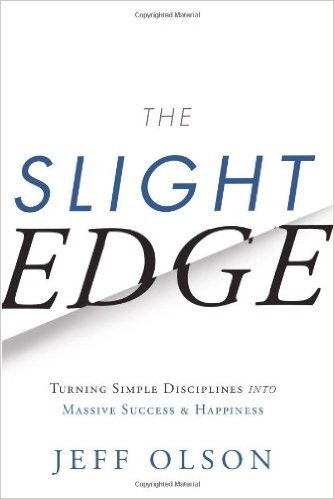
The Slight Edge, a fantastic personal development book written by Jeff Olson, is all about how you can improve in life and reach your goals. The Slight Edge is all about doing a little bit each day and finding success through simple actions.
“The only person you are destined to become is the person you decide to be.” – Ralph Waldo Emerson
You have complete control over the direction that the rest of your life takes.
 Humans are creatures of habit. Every day, we make simple decisions: what to eat, should we exercise, should I call my parents, should I read my book, etc.
With these decisions, there a few questions that come with them:
- Are the decisions you are making helping your life?
- Or are they detrimental to your life?
- Are they bringing you closer to your goals?
- Or are you still a long time away from achieving those goals?
The Slight Edge, by Jeff Olson, walks us through a strategy to achieve success in anything we want in life.
What do you want to achieve in your life? Well, first, you have to start. You have to be consistent. A positive attitude helps keep you going, and with consistent actions over time, you can achieve your goals and create the life you want to create.
The rest of this post includes a summary of The Slight Edge, takeaways from The Slight Edge, and a reading recommendation for you.
Your philosophy creates your attitudes, which create your actions, which create your results, which create your life.
Book Summary of The Slight Edge
The Slight Edge is a mindset and a way of living a life of success.
Having a slight edge in your life is your ticket to success and a life that you want.
With the Slight Edge, you can accomplish anything and everything you can dream of doing.
The best part of all of this is that The Slight Edge is actually a pretty simple concept.
What is the Slight Edge?
So, what is the Slight Edge?
Essentially, the slight edge is your philosophy of life.
The slight edge is your driving force; your philosophy creates your attitudes, which creates your actions, which creates your results, which create your life. You should live your philosophy each day.
By performing tasks which will are located on the path to your goals, you can achieve anything.
The following is a graphic of the Slight Edge:

The Slight Edge is a mindset and philosophy that is all about doing the little things. By be disciplined in the details, all of the bigger picture things and actions will be taken care of over time.
What are some examples of The Slight Edge?
One of the best examples of The Slight Edge comes from personal finance. The power of compounding and compound interest is such a great example of the Slight Edge.
You can see this from the following example and question:
Would you rather receive $1 million dollars today, or would you rather take a penny, but double it every day for a month?
The first day, you have 2 cents, the second day, you have 4 cents, the third day, you have 8 cents… two weeks in, you have $81.92. Well, guess what? At the end of the month, you end up with over $10 million dollars. You only started off with a penny, what happened?
That’s the power of time and the slight edge.
Yes, you started off with a small amount, and for a long time, you didn’t have much, but 30 days later, boom, $10 million bucks – much more than $1 million!!!

Another example of The Slight Edge is with working out. At first, you are weak, but over time, if you are consistent, you will get into shape, build your dream body and become strong.
It won’t happen overnight, but you will find success.
“Be not afraid of going slowly; be afraid of standing still.” – Chinese Proverb
Powerful Quotes from The Slight Edge
Below are a number of powerful quotes from The Slight Edge.
These The Slight Edge quotes are all about self improvement and how you can become better as a person by applying the principles and concepts of The Slight Edge.
- What you do today matters. What you do every day matters. Successful people are those who understand that the little choices they make matter and because of that they choose to do things that seem to make no difference at all in the act of doing them, and they do them over and over and over until the compound effect kicks in.
- The secret of time is simply this: time is the force that magnifies those little, almost imperceptible, seemingly insignificant things you do every day into something titanic and unstoppable.
- In a world filled with instant coffee, instant breakfast, instant credit, instant shopping, instant information, and 24/7 news, we have come dangerously close to losing touch with reality and believing we have access to instant life. But life is not a clickable link.
- Successful people form habits that feed their success, instead of habits that feed their failure.
- Growth creates abundance, and that abundance in turn creates responsibility. The more success we have, the more greatness we step into and the more abundance we experience, the more responsibility we have to the world around us.
- Success doesn’t come out of nowhere. It can’t be conjured up out of thin air, brought to you by the genie from Aladdin’s lamp simply because you rubbed it and thought good thoughts. Success does come from a small beginning, often a beginning so tiny that it seems invisible and most people miss it. But there has to be a beginning.
- All true success is built from a foundation of study plus street smarts.
- “Knowledge without practice is useless and practice without knowledge is dangerous.” – Confucius
- You truly are the average of the five people you spend the most time with, in all aspects of your life.
- Show me where you fish and I’ll show you what you catch.
- Every decision you make is a slight edge decision.
Each of these Slight Edge quotes are fantastic and I use them in my life when I need motivation.
Takeaways from The Slight Edge
With all books you read, it’s important to have takeaways and action steps to apply in your life.
If you don’t apply what you’ve read, then what’s the point of reading a self help book?
For me, The Slight Edge taught me that I need to treat everyday with purpose and to live intentionally.
One of my favorite quotes from The Slight Edge is the following:
What you do today matters. What you do every day matters. Successful people are those who understand that the little choices they make matter and because of that they choose to do things that seem to make no difference at all in the act of doing them, and they do them over and over and over until the compound effect kicks in.
Every day, I try to apply The Slight Edge and do a little bit to get closer to my goals.
Each day, even if it’s just doing a little bit of work for fifteen minutes, going on a walk, or trying to learn something new, I know that as long as I do just a little bit, I can push myself along to on the path to success.
With this slight edge philosophy and slight edge mindset, I know that with my efforts, I can achieve anything I want in my life.
I can create a life which is the life I want.
The Slight Edge book has been life changing for me, and I hope it will be life changing for you as well.
The Mastermind Within Recommends The Slight Edge
The Slight Edge is a fantastic book and a great addition to my library. I plan to read it many times over in the coming years. It was a motivating, easy, and refreshing read.
For you, I definitely recommend The Slight Edge and think it would be a great addition to your library. Reading The Slight Edge will help you cultivate a winning mindset and a mindset towards taking action.
It’s all about taking small and simple disciplines and turning these into wild success. Focusing on the daily actions you can control will allow you to achieve your goals and dreams.
Start today and watch yourself grow into what you want.
Readers: What daily habits do you have which have been beneficial to your success? Do you have any bad habits you want to get rid of? Have you experienced the compound effect in your life?
Erik

When you are stuck, knowing when to push, or when to take a break can be crucial for your long term success. Sometimes pushing through a setback can be a good strategy, while other times taking a break can be good. In this post, I’m going to give you some tips on how to deal with a setback.

Over the past few months, I’ve been working out multiple times a week. Through this time, I’ve been getting stronger and progressing very nicely, but I’ve had a setback.
Last night, I went to do some push-ups, and didn’t warm up enough.
After a set of ten push-ups, I felt a numbness in my chest right at the front of my armpit.
I didn’t know what had happened, but knew my chest workout was done.
After some research online, I determined I’d pulled my pectoralis major, and I should apply ice and rest for a few days to make sure it doesn’t develop into something worse.
Ugh.
Working out multiple times a week has been a huge part of my life this year, and to need to take a break from all things upper body (which is tough since I primarily rock climb) will be tough, but hopefully I can come back even stronger with rest.
Since I’m now resting for the next few days, I figured I’d write about what I’m going to do to rest, recover, and how I’m going to deal with this setback.
In this post, I’m going to discuss five tips for you to apply in your life if you are dealing with a setback.
5 Things to Do to Deal With a Setback
Setbacks are not fun, but with the right strategy and game plan, you can overcome your setback and get around that obstacle.
Below are 5 things you can do to deal with a setback and find success:
- Breathe and Relax
- Reflect on Your Current Situation
- Focus Your Mind on Other Tasks
- Understand Progress Takes Time and Setbacks are Inevitable
- Distance Yourself from the Problem and Come Back at a Later Time
Let’s dive into each of these in more detail below.
Taking action and living intentionally will lead to success over time. By following the steps above, you can crush this setback and get back on the right path.
1. Breathe and Relax
First, take a deep breath and collect yourself.
LIFE IS NOT LINEAR!
Life is full of twists, turns, highs and lows.
I don’t know where I’m going to be tomorrow, and I need to adapt on a daily basis to what I’m given to do my best in the next moment.
Everyone experiences a setback once in a while, and the people who are MOST successful are the ones who can bounce back.
Starting off with getting over your setback, focus on your breathing.
Breathing allows you to slow down, get your bearings, and relax.
Your brain needs air to think and process information! Give your brain what it needs! 🙂
2. Reflect on Your Current Situation
Next, after breathing, reflect on your current situation.
A few questions you could ask yourself are:
- What was the cause of your setback?
- Could you have done anything different?
- Is there anything you can do in the future differently to bring about a better outcome?
- What’s the best next steps you can take to get back on the path to your goals?
For me, I know the cause of my injury: i didn’t warm up enough and pushed too hard too early in the workout. I could have warmed up more and not been so aggressive.
After I recover, I’ll be more careful with my warm ups, and for the next few days, I’m not going to do any upper body exercises.
For you, listening to your body and listening to those around you who know what they are talking about will be best for moving on in your life.
3. Focus Your Mind on Other Tasks
While it might seem like the best choice in the moment to keep pushing and grinding away at a task, sometimes focusing on some other task can be very beneficial.
Do you ever get your most inspiring thoughts in the shower or when doing other mundane tasks?
Sometimes my best ideas come to me when I’m vacuuming or brushing my teeth!
Focusing your mind on something else that is routine and doesn’t take that much brain power can lead to making a breakthrough and getting over the hump.
Your subconscious brain will keep working in the background, and when you come back to your problem, you’ll be ready to rock!
4. Understand Progress Takes Time and It’s Okay to Take Breaks
 4. Understand Progress Takes Time and It’s Okay to Take Breaks
As I mentioned above, life is not linear.
However, taking it a step further, progress takes time and it’s okay to take breaks.
What I mean by this is your body and progress actualizes when you rest.
For example, when you workout, you are breaking down your muscles. When you rest, your muscles build back up and you become stronger.
When you are learning, you only get long term retention through repetition and allowing your brain to absorb information over time.
Taking a break and allowing yourself to recover sometimes is the best way to move forward.
5. Distance Yourself From the Problem and Come Back at a Later Time
Do you need a vacation?
As I mentioned in point number three, focusing on other tasks and giving yourself a break can be a great strategy when trying to get past a setback.
But one other thing to consider is literally distancing yourself from a problem and allowing yourself to the space to grow and recoup for another day.
A vacation might be best, but sometimes just going for a walk, going for some exercise, or going out with friends can help you distance yourself from the problem.
For me, this will be hard since my chest is part of me, but if I focus on doing leg exercises, reading, getting out in nature, and spending time with family, I can distance myself from my injury and get back on the path to success.
Get Past This Setback and Get on the Path to Success
Getting past a setback and getting back on the path to success might take a few days or weeks, but you can do it.
I’m upset with my injury right now, but I know if I rest for a few days, I can get back to full strength.
One benefit will be having more time to rest my entire body and give me more time to write, catch up on other tasks, and be with family.
There’s always pros and cons to every situation, and with any setback, being able to take a break, look at the bright side, and move on will be most beneficial.
Hopefully you can get past your setback and get back on the path to achieving your goals.
Readers: what tips do you have for when you need to take a break? How do you deal with setbacks?
Thanks for reading,
Erik

Planning for your best year ever is important if you want to have your best year ever. First, by figuring out what you want, you can then make an action plan for a fantastic year.

With only a little bit more time until the start of the new year, it’s time to start planning for what you want in the next year.
What if I said you could have your best year ever next year?
Do you want to have a great year? What would having a great year look like? Is there anything in the way from making this happen?
Here’s a fact: you deserve the best and you have the potential to CREATE the best for yourself.
You are smart, powerful, and the creator of your life.
In this post, I’m going to present you with the steps you can take to plan for your the year of your dreams.
First, it’s important to figure out what you want, and then after, you can start setting goals and creating an action plan to making next year the best year ever.
Two Questions to Answer for Planning Your Best Year
First, without questions, there are no answers.
Planning for your best year can’t start without breaking it down into smaller questions which get at the core of who you are, how you enjoy your time, and what you like to do on a daily, weekly, and monthly basis.
I believe there are two question sets which will get you started towards creating your dream year. The first part of the two sets of questions is:
When are you most happiest and what are you doing when you are experiencing this joy?
This is a simple question. When do you feel happiest? What activity or thing are you doing which brings the happiness?
For me, happiness comes from having new experiences and connecting with others to learn and help them grow.
Happiness also comes from doing things on my own terms and having the freedom to create what I want when I want.
What’s your answer? After you have it, you can move on to the next question.
The second part of this set of questions is:
How often are you able to do these activities, and what’s holding you back from experiencing them whenever you’d like?
If you are already doing what makes you happy all the time (from the first question), then the second question doesn’t really make sense.
In my opinion, your best year will be about pushing towards doing what makes you happiest and understanding that while today might not be where you want to be, over time you can get there.
Right now, I’m starting to plan for my next year. There’s so much I want to do, but mainly I want to travel, keep exercising, and improving my relationships.
For you, again, it starts with answering the two questions above, and having these thoughts in your head for when you go to create your goals and a plan.
Now that you have these thoughts in your head, below are 5 concrete steps for you to take control of next year and make a plan for success and happiness.
5 Steps for Planning Your Best Year
When beginning to think ahead about next year, we first need to start with questions and goals.
First, let’s identify what you want with your year.
We both only have one year and limited time. In my year, I want to be doing things I enjoy and that are bringing joy to the people around me.
After understanding your goals and dreams, then it’s time to come up with a game plan, and take bold action.
The 5 steps for making next year your best year are:
- Identify Your Goals and Dreams
- Create a Happiness Game Plan
- Be Intentional and Take Action
- Be Consistent with Your Actions
- Plan to Reassess and Tweak Things Over the Next Year
Let’s dive into each of these steps individually now in more detail.
1. Identify Your Goals and Dreams
What are your goals? What makes you happiest? Where do you want to be in 1 year?
As we discussed in the last section, there is a lot that goes into answering these difficult questions.
However, with a picture of what you want, you can start to work towards your dream year and ideal situation.
Split your goals, thoughts, and dreams into multiple buckets:
- social
- financial
- spiritual
- physical
- emotional
- work
- fun
Some example questions for you may be:
- Do you want to get a promotion or change in responsibilities at work?
- Would you want more money in the bank?
- Would you be happy if your business made an extra $1,000 a month?
- Do you want to be able to take more vacations with your family?
- Are you looking to start a new hobby?
- What things stress you out?
- Do you want to lose 10 pounds?
After asking yourself these questions, KEEP GOING! Let your powerful brain do some more work!
After getting some answers to the questions which matter to your situation, now it’s time to work backwards.
2. Create a Happiness Game Plan
You know your goals, now it’s time to come up with a game plan.
You have your dream. What do you have to do to MAKE it happen?
Let’s take the example of losing 10 pounds.
If you want to lose 10 pounds, it’s time for more questions. Let’s see how this line of thinking plays out:
- How is a person’s weight determined?
- A person’s weight is determined through a number of factors, but changes come from daily habits and a simple equation: calories in minus calories out.
- If weight changes come from calories in minus calories out, then how do I decrease this amount for myself?
- First, what does this equation look like for you today? What gets measured, gets managed!
- After measuring where you are at on a daily basis, are you in a calorie surplus or calorie deficit?
After you’ve asked and answered these questions for yourself (and there are probably 3+ more levels to go if you want to go that deep), again KEEP GOING!
Let your powerful brain and body work towards your goals and dreams!
Writing down your thoughts, creating S.M.A.R.T. goals, and telling others about your plan are all great ways to set goals once you’ve came up with your plan.
After coming up with your game plan for success and happiness, it’s now time to take ACTION.
3. Be Intentional and Take Action
 3. Be Intentional and Take Action
It’s great to know what you have to do, but if you never take action, you will never achieve your goals and dreams.
Intentional living is all about taking action and working on bettering your year situation.
Sitting on the couch and watching Netflix is fun and relaxing, but it probably won’t lead to a very fulfilling year (unless watching Netflix 24/7 is part of your dream year…).
Taking action (for me) involves getting out and into the world.
Start today with your actions and live intentionally. You’ll be pleased as you start to see your dream year come to fruition.
“A journey of a thousand miles begins with a single step.” – Lao-Tzu
“An ounce of action is worth a ton of theory.” – Ralph Waldo Emerson
4. Be Consistent With Your Actions
Humans overestimate what they can do in a day, but underestimate what they can do in a year.
Have you ever started on your goals only to stop? Did you end up reaching your goal?
Each day, if you can spend at least 10 minutes working towards your goals, you’ll be amazed at your progress.
At the end of one year, you will have spent 3650 minutes, or 60 hours.
60 hours over a year? How much closer to your goals would you be after 60 hours?
That’s the power of consistency. Consistent actions over time WILL lead to massive success.
5. Reassessing and Tweaking Your Game Plan Over Time
 5. Reassessing and Tweaking Your Game Plan Over Time
From time to time, you will need to see if you are still on track.
I stay accountable to myself monthly. You can do a personal check-in weekly, monthly, or every few months. It’s up to you.
If you aren’t on track, make the necessary changes to your actions and daily habits to ensure you are working towards your goals.
It’s okay if you realize you aren’t on track; this doesn’t mean you failed.
All this setback means is you now have the opportunity to pick back up where you left off and keep getting better!
Just because you eat one unhealthy meal doesn’t mean your whole healthy eating plan is ruined. It just means you ate one unhealthy meal. You can always continue eating healthy for your next meal, and it will in fact be beneficial.
This outlook works for every part of your plan.
Being self aware on your path to the year you want and deserve will help tremendously.
Living an intentionally requires patience and understanding, and also will require some flexibility.
Having your best year obviously won’t happen in the first day, but the next 12 months, through tweaks and consistency, you’ll get there. 🙂
Starting Planning for Your Best Year Ever and Make it Happen
With this post, I’m excited to see what you come up with for your dream year.
Again, you deserve the best and with your plan, you can achieve and create the best for yourself.
In a year, you’ll thank yourself for taking action and living your life to the fullest.
Thanks for reading!
Readers: what do you want to make happen next year? What does your best year look like? What steps do you need to take to make your best year happen?
Erik

Reading personal development books are a fantastic way for you to learn what is necessary to grow as a person. This post has 11 personal development books you can read for personal growth.

Personal development is essential for your success as a human.
If you are looking to master your life and become a little bit better each and every day, reading books can be a great way to get starter.
While self improvement and learning how to become better can be tough, but it is possible.
By devoting time each and every day to your personal development, you will grow, and achieve success at the highest levels.
In this post, you’ll learn about 11 books which will be very beneficial for your personal improvement. These book recommendations for personal development will help you get started on your self improvement education!
Your level of success will rarely exceed your level of personal development, because success is something you attract by the person you become.
11 Personal Development Books to Read for Growth
You want to become a person who will naturally succeed and find success. By reading, learning, and applying what you have learned, you can get on to:
In the following sections, I’ve listed 11 personal development books you can review and read for your own personal development.
The 11 books you can read for personal development are:
- The 5 Love Languages
- How to Win Friends and Influence People
- The Seven Habits of Highly Effective People
- The Miracle Morning
- The Slight Edge
- The Power of Positive Thinking
- Getting Things Done
- The Alchemist
- Everyone Communicates, Few Connect
- Emotional Intelligence
- Think and Grow Rich
Below is a summary of each of these personal development books. By studying these books for personal development, you will see your level of personal success skyrocket.
1. The Five Love Languages, by Gary Chapman

Falling in love is easy. Staying in love—that’s the challenge. How can you keep your relationship fresh and growing with the demands, conflicts, and plain boredom of everyday life?
In the #1 New York Times bestseller The Five Love Languages, you’ll discover the secret that has transformed millions of relationships worldwide.
Whether your relationship is flourishing or failing, Dr. Gary Chapman’s proven approach to showing and receiving love will help you experience deeper and richer levels of intimacy with your partner.
Reading The Five Love Languages will be very beneficial for your success with relationships.
2. How to Win Friends and Influence People, by Dale Carnegie

For more than sixty years the rock-solid, time-tested advice in How to Win Friends And Influence People has carried thousands of people up the ladder of success in their business and personal lives.
In How to Win Friends And Influence People, you will learn:
- Three fundamental techniques in handling people
- Six ways to make people like you
- Twelve ways to win people to you way of thinking
- Nine ways to change people without arousing resentment
Check out How to Win Friends And Influence People.
3. The Seven Habits of Highly Effective People, by Stephen R. Covey

When it was first published in 1989, The 7 Habits of Highly Effective People was an almost instant bestseller.
With over 25 million copies sold worldwide in over 40 languages since its first publication, this book continues to help millions of readers become more effective in both their personal and professional lives.
The Seven Habits of Highly Effective People has influenced presidents, CEOs, educators, and individuals all over the world.
It has helped improve their businesses and careers and helped them live with integrity, service, dignity, and success in all areas of life. It has had an undeniable impact for the past 25 years–and will no doubt continue to be influential for many more.
Check out The Seven Habits of Highly Effective People.
4. The Miracle Morning, by Hal Elrod

What if you could wake up tomorrow and any—or EVERY—area of your life was beginning to transform? What would you change?
The Miracle Morning is already transforming the lives of tens of thousands of people around the world by showing them how to wake up each day with more ENERGY, MOTIVATION, and FOCUS to take your life to the next level.
It’s been right here in front of us all along, but this book has finally brought it to life.
Are you ready? The next chapter of YOUR life—the most extraordinary life you’ve ever imagined—is about to begin. It’s time to WAKE UP to your full potential…
Check out The Miracle Morning.
5. The Slight Edge, by Jeff Olson
The Slight Edge is a way of thinking, a way of processing information that enables you to make the daily choices that will lead you to the success and happiness you desire.
Learn why some people make dream after dream come true, while others just continue dreaming and spend their lives building dreams for someone else.
The Slight Edge is not just another self-help motivation tool of methods you must learn in order to travel the path to success. The Slight Edge shows you how to create powerful results from the simple daily activities of your life, by using tools that are already within you.
Check out The Slight Edge.
6. The Power of Positive Thinking, by Norman Vincent Peale

In The Power of Positive Thinking, Dr. Peale demonstrates the power of faith in action. With the practical techniques outlined in this book, you can energize your life. You’ll learn how to:
- Believe in yourself and in everything you do.
- Build new power and determination.
- Develop the power to reach your goals.
- Break the worry habit and achieve a relaxed life.
- Improve your personal and professional relationships.
- Assume control over your circumstances.
- Be kind to yourself.
Check out The Power of Positive Thinking.
7. Getting Things Done, by David Allen

Since it was first published almost fifteen years ago, David Allen’s Getting Things Done has become one of the most influential business books of its era, and the ultimate book on personal organization.
“GTD” is now shorthand for an entire way of approaching professional and personal tasks, and has spawned an entire culture of websites, organizational tools, seminars, and offshoots.
If you want to make great personal development gains, Getting Things Done will be a great book to read and implement in your life.
Check out Getting Things Done.
8. The Alchemist, by Paulo Coelho

Combining magic, mysticism, wisdom and wonder into an inspiring tale of self-discovery, The Alchemist has become a modern classic.
Paulo Coelho’s masterpiece tells the mystical story of Santiago, an Andalusian shepherd boy who yearns to travel in search of a worldly treasure.
His quest will lead him to riches far different—and far more satisfying—than he ever imagined.
Santiago’s journey teaches us about the essential wisdom of listening to our hearts, of recognizing opportunity, and following our dreams.
Check out The Alchemist.
9. Everyone Communicates, Few Connect, by John Maxwell

Only one thing stands between you and success. It isn’t experience. It isn’t talent.
World-renowned leadership expert John C. Maxwell says if you want to succeed, you must learn how to connect with people.
While it may seem like some folks are just born with it, the fact is anyone can learn how to make every communication an opportunity for a powerful connection.
The ability to connect with others is a major determining factor in reaching your full potential.
It’s no secret! Connecting is a skill you can learn and apply in your personal, professional, and family relationships―and you can start now!
Check out Everyone Communicates Few Connect.
10. Emotional Intelligence, by Daniel Goleman
 Everyone knows that high IQ is no guarantee of success, happiness, or virtue. Until Emotional Intelligence, we could only guess why.
Through vivid examples, Goleman delineates the five crucial skills of emotional intelligence.
Goleman shows how they determine our success in relationships, work, and physical well-being. What emerges is an entirely new way to talk about being smart.
The best news is that “emotional literacy” is not fixed early in life. Every parent, every teacher, every business leader, and everyone interested in a more civil society, has a stake in this compelling vision of human possibility.
Check out Emotional Intelligence.
11. Think and Grow Rich, by Napoleon Hill

In Think and Grow Rich, Napoleon Hill draws on stories of Andrew Carnegie, Thomas Edison, Henry Ford, and other millionaires of his generation to illustrate his principles of success.
Think and Grow Rich will teach you the secrets that could bring you a fortune.
Think and Grow Rich will show you not only what to do but how to do it. Once you learn and apply the simple, basic techniques revealed here, you will have mastered the secret of true and lasting success.
Check out Think and Grow Rich.
Read these Awesome Personal Development Books for Personal Growth!
Personal development is extremely important for success in life.
The self improvement books above will supercharge your personal development skills and help you at work, in social situations, and at home.
Becoming more valuable as a person can only happen through dedicating time to becoming better.
With these books, you can make it happen.
Readers: what’s your favorite personal development book? Which one from above looks most interesting to you?
Erik

Overcoming self doubt is a common problem when trying to become successful in life. Self doubt can creep in to anyone’s thoughts, and luckily, there are some ways to overcome self doubt and unlock your full potential.

Lately, I’ve been dealing with some self doubt and anxiety in a few areas of my life.
One of those areas is becoming a better indoor rock climber and becoming stronger over time.
As I’ve started to progress as a rock climber, there have been numerous times where I get into sticky situations on the wall, and I doubt my ability to make it to the next hold.
I look up to the next hold, a mere two feet above me, and begin to feel uneasy about my current situation.
When I’m bouldering, this is understandable, as I can be over five to ten feet up in the air.
But the interesting thing is, when I push through my self doubt in those moments, I’m usually able to do the move I didn’t think I could do.
My body physically could make the move, even when my brain was telling me no.
This has been happening to me for the past few weeks, and now that I’m aware of this self doubt, I’ve been able to overcome and push through some of the existing barriers to become better.
In this post, I’m going to share with you some tips on how you can overcome self doubt, boost your self confidence, and unlock your full potential.
By the end of this post, my hope is you will have some actionable steps in your life to overcome self doubt.
 Overcoming Self Doubt and Anxiety Around Not Being Enough
 Overcoming Self Doubt and Anxiety Around Not Being Enough
Before going into the tips for overcoming self doubt, I want to revisit my experience with rock climbing.
A feeling I’ve had repeated over the past few weeks has been a feeling of discomfort when I get into tricky situations.
One such example was when I was climbing a 5.10- route, which kind of snaked up the wall, and had an overhang at the top.
At the top of the route, you have to stick your arms into a crack, create tension in your body, and lift both feet onto higher holds to get to the next good handhold.
The first few times I tried this, I wasn’t confident enough in my ability, and didn’t trust myself to be able to execute the move.
The last time I did this route, I made a less than full effort and fell off the wall (I was completely safe, but had to climb up a little bit to get back to the same spot).
Holding on, I told myself I had to give it 100% and trust my strength.
Even though it felt awkward, I gave it my all, and executed the move. It actually wasn’t as hard as I thought it was, and I was ecstatic about my success.
Why couldn’t I have done this the first time? Why did I doubt myself? What could I have done to be more confident the first few times around?
These are questions I keep asking myself, and I think I’m finally getting closer to the answers.
Now, let’s talk about some tips for overcoming self doubt, increasing your self confidence, and unlocking your full potential.
7 Tips to Overcome Self Doubt and Boost Self Confidence
Unlocking your full potential and getting over self doubt is possible with the right set of steps and tips. Below are 7 things for you to consider when looking to increase your self confidence and get on the way to achieving your goals.
- Become Self Aware of Your Abilities
- Practice the Power of Positive Thinking
- Talk to Others about Your Situation
- Realize Setbacks and Barriers are Temporary Steps to Your Goals
- Keep Working on Your Skills
- Experiment With Different Approaches
- Remember Consistent Actions Added Up Lead to Massive Success
Let’s now dive into each of these in more detail below.
1. Become Self Aware of Your Abilities
 1. Become Self Aware of Your Abilities
Self awareness is the first step towards becoming a success and reaching your goals.
By reading this article, and recognizing your self doubt and self confidence can be improved, I can tell you already have a good sense of self awareness.
Self awareness of when you are struggling is the first step to improvement.
Next, a self awareness around your current skills and abilities is also important.
Is your self doubt a function of:
- Needing more training?
- Not having the proper knowledge?
- Needing a more diverse set of experiences and perspectives?
- Having external pressures?
- Needing more time to work things out for yourself?
By answering these questions, you can figure out where you need to improve for reaching your goals.
If there are legitimate barriers to your progress, then maybe you can remove self doubt by addressing these barriers.
If the barriers are in your head, then maybe it’s best to work on your mindset and boost your confidence through affirmations.
2. Practice the Power of Positive Thinking and Affirmations
Your brain is incredibly powerful. The thing about our thoughts is that they can quite literally create and shape your reality.
If you believe in yourself and believe in what you are doing, you can make it happen.
By using affirmations and positive thinking, you can manifest your wants and dreams into your life.
By saying “I can do it” and “I’m a confident person”, you will become someone who can do whatever you want in your life, and you will become confident.
Using positive thinking can help you on your way to becoming more confident in your abilities.
3. Talk to Others about Your Situation
While I believe everyone can find the answers to any question they have, sometimes getting a second (and honest) opinion from a friend or family member can help with self doubt.
Not everyone is an expert on everything, but many people have a wide set of experiences and perspectives on life, and can give you insight into what you could try to improve your situation.
 4. Realize Setbacks and Barriers are Temporary Steps to Your Goals
 4. Realize Setbacks and Barriers are Temporary Steps to Your Goals
Success and achievement does not happen from going from point A to point B.
When making plans, it is always nice to lay things out in a linear manner, but in reality, nothing is linear. As Murphy’s Law states, what can go wrong, will go wrong.
But, if you have the mindset that setbacks are temporary and necessary, then you can accept this failure and move on to the next task.
Right now, I’m dealing with some elbow tendinitis, and can’t always give it my all at the gym.
But, I recognize this and am allowing myself to rest and recover.
I know I’ll be back to 100% soon, and then I can continue to progress to my goals.
5. Keep Working on Your Skills
As Stephen Covey says in his book, The 7 Habits of Highly Effective People, sharpening the saw is important before making a cut.
What he means by this is that through learning, experience, and growth, you can improve as a person to become more successful in what you are looking to accomplish.
If you are stuck in a rut, going back to the basics can give you confidence to proceed. Maybe taking a break and reassessing the next day is the best move.
Sometimes taking a step backward can lead to two steps forward with a new skill or perspective in hand.
6. Experiment with Different Approaches
Similar to the last section, experimentation and gaining new experiences can help with whatever task you are struggling with.
I love experimenting with different things at work when it comes to my programming and coding, and also I’ve looked to do this in other areas (diet, eating habits, exercise, and side hustles).
When you experiment, instead of taking some one else’s instruction, you make original connections in your brain for yourself.
Those first hand connections are so powerful and can help you make even more original connections in your brain for your next tasks.
7. Remember Consistent Actions Added Up WILL Lead to Massive Success
 7. Remember Consistent Actions Added Up WILL Lead to Massive Success
Success is simply the sum of simple daily disciplines and actions.
When starting off, it’s very tough to see any progress.
However, the power of compounding is incredibly powerful.
Think about pushing a massive rock – at first, you can barely push it. But, after pushing more and more, all of a sudden, the rock starts to move and turn over on itself.
As time goes on, you barely have to push.
That’s the power of compounding and consistency.
So many people fail to get to that breaking point, and instead give up.
You need to commit to consistency and action if you want to find success and master your life.
By committing to action and doing, you will be able to figure out what is best for your situation and get on to achieving your dreams.
Eliminate Self Doubt and Get on to Achieving Your Dreams Today!
Getting rid of self doubt and boosting your self confidence can seem like something which is impossible, but I can assure you that you can make it happen for yourself.
Improving a little bit on your mindset and habits each day can help you get towards getting that promotion at work, breaking through a fitness barrier, or helping you become more social.
Cultivating self confidence and having a strong, positive image of yourself in your head might not happen over night.
But, by working on boosting self confidence and removing self doubt from your focus, you can improve.
Thanks for reading!

Eggs are an easy to make and inexpensive food to eat to get a lot of protein and nutrients. Eggs are a superfood and might make sense to include in your diet. In this article, I’m going to share with you why I eat more than 30 eggs a week.
I eat a lot of eggs every week.
Usually, I’ll go through 30 eggs a week, and it seems I’m always buying a new container at the store.
For me, throwing some butter, or olive oil, in a pan, cracking 5 eggs and scrambling them up is a great way to get my protein for a meal.
Eating eggs is very good for you and can help you reach your fitness and health goals.
Now, you don’t need to eat as many eggs as me, but if you don’t eat eggs at all, then hopefully this article will inspire you to give them a try!
In this article, I’m going to share with you why I eat over 30 eggs a week, and some reasons why eating lots of eggs can help you reach your goals.
Why I Eat Lots of Eggs Every Week
Let me tell you about myself: I like to keep things simple.
When it comes to my eating habits, I especially like to keep things simple.
For me, I wouldn’t quite say I’m a bodybuilder, but the thought behind my diet is inspired by bodybuilders.
In my diet, I look to:
- have around 100 grams of protein a day
- eat a high amount of healthy fats (nuts for example)
- and have a low to moderate amount of carbohydrates
Since I work out a number of days a week, I’m not too concerned with my calories. Also, if I overdo one day, then I clean it up the next day.
With this diet plan, I’m able to eat basically anything in moderation, but typically, I’ll have two or three high protein meals a day, and snack on nuts, fruits and vegetables between those bigger meals.
As someone who is also interested in being financially successful, I also look to eat inexpensively.
What is an inexpensive food which is high in protein and is packed with a ton of nutrients? Eggs.
I love eggs and have been eating lots of eggs for a number of years now.
Eggs are fast and easy to make, are relatively inexpensive, are high in protein, and are relatively lower in calories.
With all of these benefits, these fit right into my simple diet plan.
I eat 5 or 6 eggs a day (either for lunch or dinner because I practice intermittent fasting and don’t eat breakfast), and eat over 30 eggs a week.
But these are just some of the reasons why eggs are amazing, and in the next section, I’m going to dive into the 3 reasons why I believe eggs should be included in your diet.
3 Reasons Why I Eat Lots of Eggs
Eggs are a superfood and can be a great addition to any diet plan. Eggs have many benefits.
3 main reasons why I eat lots of eggs are:
- Eggs have many health benefits and nutrients
- Eggs are high in protein
- The cost of eggs is relatively inexpensive
Let’s dive into these benefits of eggs in more detail now in the following sections.
1. Eggs Have Many Health Benefits and Nutrients
It’s a fact that eggs have many health benefits and nutrients.
Eggs are incredibly nutritious, because, as you may know, a whole egg has everything needed to produce a baby chicken!
Eggs are a superfood, and with vitamins A, B, D, E, K and other minerals, they have a little bit of almost every nutrient you need to be healthy!
Also, eggs can have many weight loss benefits.
In a study in overweight adults, calorie-restricted diets that included either eggs or a bagel for breakfast were compared; the people who consumed eggs for breakfast lowered their body mass index by 61 percent, lost 65 percent more weight, and reported feeling more energetic than those who ate a bagel for breakfast.
That study has some incredible results, and this is just more evidence for the benefits of eggs.
2. Eggs are High in Protein
One of the main reasons I love eggs is how they are high in protein.
Depending on the size, a single egg will have between 5 and 7 grams of protein.
This protein is high quality and contains all the essential amino acids necessarily for muscle growth.
In addition to being high in protein, eggs have a few grams of healthy fat, and no carbs.
Eggs are usually around 75 calories, and with this, you have a high protein, high fat and low calorie food which is filling and nutrients – again a perfect food to include in your diet!
For me, if I have 6 eggs, this will mean I’ll have a dish with:
- around 450 calories
- 35 grams of protein
- 30 grams of fat
- and little to no carbs.
For my physical fitness and health goals, this dish is fantastic for pre- or post-workout.
I’m looking to get to my dream body, and eggs are a great help towards this goal.

3. Eggs are Relatively Inexpensive
As someone on the path to financial freedom, I’m conscious of what I’m spending my money on, and how much I save every month.
One last reason why I love eggs is how cheap they are. For me, when I shop at my local target, I’m able to get 18 eggs for less than $2.
When I make eggs, I typically scramble 5-6 eggs. From a cost perspective, 6 eggs is less than $0.75.
For roughly 30 grams of protein, this is the start of a pretty cheap and high protein meal!
During the week, I eat over 30 eggs, and since I’m able to buy these eggs at such a good price, my weekly expense for my egg purchases is usually around $5 a week.
If I was to go out, I’d spend a lot more money on food. With making eggs, I’m able to save a lot of money by eating in.
Eat More Eggs Today to Save Money and Improve Your Health!
I love eggs and I hope this article has inspired you to start including eggs in your diet.
Whether you are looking to get stronger, lose weight, or feel healthier, I believe eggs have a place in your diet.
You don’t need to have eggs every day, but having a few eggs a few times a week could make a big difference in your health.
Hope you enjoyed this article, and thank you for reading!